


One interface. 31 changepoint methods. Every result tidy, every result plottable.
R has excellent changepoint packages, but each one takes its own
input, returns its own result object, and has its own idea of a plot —
so switching methods means rewriting your analysis. ggchangepoint puts
them behind one interface: cpt_detect() runs any of 31
detection methods, every result comes back as the same tidy
ggcpt object, and autoplot() draws it, with
confidence intervals, posteriors, penalty paths and accuracy metrics
when you need them.
Install the released version from CRAN:
install.packages("ggchangepoint")Or the development version from GitHub:
# install.packages("devtools")
devtools::install_github("PursuitOfDataScience/ggchangepoint")library(ggchangepoint)
library(ggplot2)Generate a series with a mean shift:
set.seed(2022)
x <- c(rnorm(100, 0, 1), rnorm(100, 10, 1))
Detect changepoints with the unified cpt_detect():
res <- cpt_detect(x, method = "pelt", change_in = "mean")
res
#> ggcpt (changepoint detection result)
#>   Method:          pelt
#>   Change in:       mean
#>   Changepoints found: 1
#>   CP convention:   left
#>   Penalty:         MBIC
#>   Series length:   200
#>
#> Changepoints:
#> # A tibble: 1 × 2
#>      cp cp_value
#>   <int>    <dbl>
#> 1   100    0.467
The result is a ggcpt S3 object, so the broom verbs work
on it: tidy() gives one row per changepoint,
glance() a one-row model summary, and
augment() the original series with segment labels, fitted
values and residuals.
tidy(res)
#> # A tibble: 1 × 2
#>      cp cp_value
#>   <int>    <dbl>
#> 1   100    0.467
glance(res)
#> # A tibble: 1 × 9
#>       n n_changepoints method change_in penalty_type penalty_value cp_convention
#>   <int>          <int> <chr>  <chr>     <chr>                <dbl> <chr>
#> 1   200              1 pelt   mean      MBIC                    NA left
#> # ℹ 2 more variables: total_cost <dbl>, runtime <dbl>
Visualise with autoplot():
autoplot(res)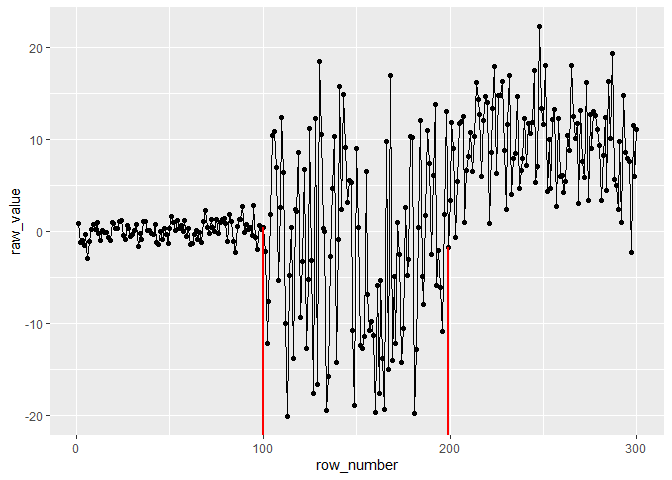
cpt_detect(x, method = "...") dispatches to 31 methods,
from classic PELT to Bayesian online detection.ggcpt object, with tidy(),
glance(), and augment().autoplot() draws any
result: changepoints, confidence intervals, fitted signals, posteriors,
multivariate facets.| Family | Methods |
|---|---|
| Penalised / optimal partitioning | PELT · BinSeg · SegNeigh · AMOC · FPOP · CPOP (slope) · fastcpd (mean/var/AR/ARMA/GARCH) |
| Multiscale / search | WBS · WBS2 · TGUH · NOT · MOSUM · Isolate-Detect · SMUCE · HSMUCE (the last two with CIs) |
| Nonparametric / kernel | ED-PELT · E-Divisive / E-Agglo · kernel running stats · NP-MOJO · sequential CPM · self-normalisation |
| Bayesian | bcp posteriors · online BOCPD · BEAST model averaging |
| High-dimensional / multivariate | inspect · ocd · geomcp |
| Regression breaks / robust | Bai–Perron · segmented · EnvCpt · DeCAFS |
Run cpt_methods() for the live table with engines and
installation status. Only three engines are required —
changepoint, changepoint.np and
ecp; every other engine lives in Suggests and
is loaded on demand, so a plain install stays light.
cpt_detect() dispatches to any supported method by
name:
cpt_detect(x, method = "binseg", change_in = "mean")
#> ggcpt (changepoint detection result)
#>   Method:          binseg
#>   Change in:       mean
#>   Changepoints found: 1
#>   CP convention:   left
#>   Penalty:         MBIC
#>   Series length:   200
#>
#> Changepoints:
#> # A tibble: 1 × 2
#>      cp cp_value
#>   <int>    <dbl>
#> 1   100    0.467
cpt_detect(x, method = "wbs", change_in = "mean")
#> ggcpt (changepoint detection result)
#>   Method:          wbs
#>   Change in:       mean
#>   Changepoints found: 1
#>   CP convention:   left
#>   Penalty:         sSIC
#>   Series length:   200
#>
#> Changepoints:
#> # A tibble: 1 × 2
#>      cp cp_value
#>   <int>    <dbl>
#> 1   100    0.467
cpt_detect(x, method = "fpop", change_in = "mean")
#> ggcpt (changepoint detection result)
#>   Method:          fpop
#>   Change in:       mean
#>   Changepoints found: 1
#>   CP convention:   left
#>   Penalty:         Manual = 17.846
#>   Series length:   200
#>
#> Changepoints:
#> # A tibble: 1 × 2
#>      cp cp_value
#>   <int>    <dbl>
#> 1   100    0.467
Use cpt_methods() to see all available and planned
methods with their engine packages and installation status:
cpt_methods()
#> # A tibble: 35 × 6
#>    method   change_in                   engine   status target_release installed
#>    <chr>    <chr>                       <chr>    <chr>  <chr>          <lgl>
#>  1 pelt     mean, var, meanvar          changep… avail… <NA>           TRUE
#>  2 binseg   mean, var, meanvar          changep… avail… <NA>           TRUE
#>  3 segneigh mean, var, meanvar          changep… avail… <NA>           TRUE
#>  4 amoc     mean, var, meanvar          changep… avail… <NA>           TRUE
#>  5 np       distribution                changep… avail… <NA>           TRUE
#>  6 ecp      distribution (multivariate) ecp      avail… <NA>           TRUE
#>  7 fpop     mean                        fpop     avail… <NA>           TRUE
#>  8 wbs      mean                        wbs      avail… <NA>           TRUE
#>  9 wbs2     mean                        breakfa… avail… <NA>           TRUE
#> 10 not      mean, var, slope            not      avail… <NA>           TRUE
#> # ℹ 25 more rowsSMUCE (smuce_wrapper(), via stepR) delivers
a confidence interval for every changepoint location; Bai–Perron
(strucchange_wrapper()) and broken-line regression
(segmented_wrapper()) do the same for regression breaks.
The intervals live in ci_lower/ci_upper
columns and render with autoplot(show_ci = TRUE) or the
geom_cpt_ci() layer:
res_smuce <- smuce_wrapper(x)
tidy(res_smuce)
#> # A tibble: 2 × 4
#>      cp cp_value ci_lower ci_upper
#>   <int>    <dbl>    <int>    <int>
#> 1     7   -1.06         2       94
#> 2   100    0.467      100      100
autoplot(res_smuce, show_ci = TRUE, show_fit = TRUE)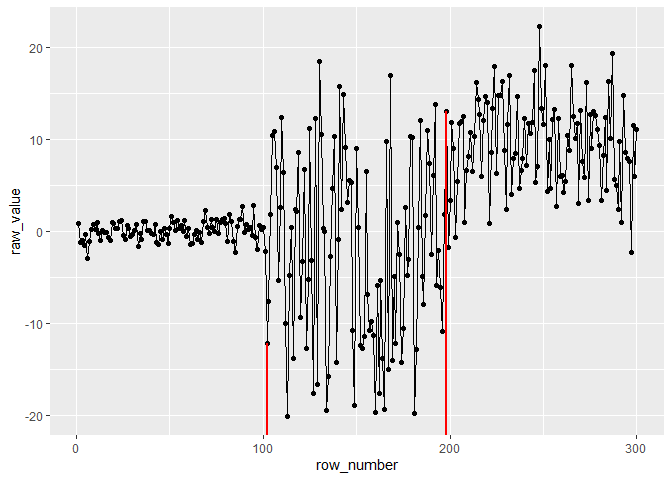
Read the intervals, not just the locations: the genuine shift is pinned to a single index, while the spurious early changepoint carries an interval nearly a hundred observations wide — exactly the distinction a bare list of locations hides.
Bayesian engines return posterior probabilities instead:
bcp_wrapper() (posterior probability of a change at every
location), beast_wrapper() (Bayesian model averaging), and
bocpd_wrapper() (online run-length posterior). Two
dedicated displays accompany them — ggcpt_posterior() and
ggcpt_runlength():
res_bcp <- bcp_wrapper(x, seed = 1)
tidy(res_bcp)
#> # A tibble: 1 × 3
#>      cp cp_value posterior_prob
#>   <int>    <dbl>          <dbl>
#> 1   100    0.467              1
ggcpt_posterior(res_bcp)
Instead of guessing one penalty, cpt_crops() computes
every optimal segmentation over a penalty range
(Haynes, Eckley and Fearnhead, 2017) and plots the elbow diagnostic, the
penalty path, or the candidate segmentations themselves:
path <- cpt_crops(c(rnorm(100), rnorm(100, 3), rnorm(100, -1)))
path
#> ggcpt_path (CROPS penalty path)
#>   Change in:       mean
#>   Penalty range:  [5.704, 57.04]
#>   Series length:   300
#>   Distinct segmentations: 2
#>
#> # A tibble: 2 × 3
#>   penalty n_cpts  cost
#>     <dbl>  <int> <dbl>
#> 1    7.68      2  274.
#> 2    5.70      4  259.
autoplot(path)                          # cost elbow
autoplot(path, type = "segmentations") # see the actual candidate models
ggcpt_compare() runs several detectors on the same
series and facets the results, so agreement (and disagreement) is
visible at a glance:
ggcpt_compare(x, methods = c("pelt", "binseg", "fpop", "wbs"))
For a numeric summary, use ggcpt_compare_table():
ggcpt_compare_table(x, methods = c("pelt", "binseg", "fpop", "wbs"))
#> # A tibble: 4 × 3
#>   method    cp cp_value
#>   <chr>  <int>    <dbl>
#> 1 pelt     100    0.467
#> 2 binseg   100    0.467
#> 3 fpop     100    0.467
#> 4 wbs 100 0.467cpt_batch() runs one detector over many series (a
matrix, data frame, or list) and returns a tidy tibble of results —
honouring future::plan() for parallel execution.
cpt_stability() bootstrap-resamples within fitted segments
and reports how often each location is re-detected, a cheap confidence
signal for engines with no native intervals:
X <- cbind(shifted = x, noise = rnorm(200))
batch <- cpt_batch(X, method = "pelt")
batch
#> ggcpt_batch (2 series, method: pelt)
#>
#> # A tibble: 2 × 2
#>   series  n_changepoints
#>   <chr>            <int>
#> 1 shifted              1
#> 2 noise                0
autoplot(batch)
st <- cpt_stability(x, method = "pelt", B = 50, seed = 1)
st
#> ggcpt_stability (50 bootstrap replicates, method: pelt)
#>
#> Original changepoints and their re-detection frequency:
#> # A tibble: 1 × 2
#>      cp stability
#>   <int>     <dbl>
#> 1   100         1
autoplot(st)
The multivariate engines accept a matrix (rows are time points)
directly through cpt_detect() and render as faceted
small-multiples:
set.seed(1)
Xhd <- cbind(a = c(rnorm(80), rnorm(80, 3)),
             b = c(rnorm(80), rnorm(80, -2)),
             c = rnorm(160))
res_hd <- inspect_wrapper(Xhd)
tidy(res_hd)
#> # A tibble: 1 × 3
#>      cp cp_value strength
#>   <int>    <dbl>    <dbl>
#> 1    80   -0.590     21.9
autoplot(res_hd)
Univariate methods never silently flatten a matrix: hand one to
pelt and you get an error naming the multivariate
alternatives instead. ocd_wrapper() insists the other way —
it projects across coordinates, so it needs a matrix with at least two
columns.
When ground truth changepoints are known, compute accuracy metrics
(precision/recall/F1 under one-to-one matching within a tolerance
margin, the covering metric, Hausdorff distance, adjusted
Rand index):
# 98 matches the true changepoint at 100; 150 is a false positive
cpt_metrics(pred = c(98, 150), truth = c(100), n = 200)
#> # A tibble: 1 × 12
#>       n n_pred n_truth precision recall    f1 covering hausdorff rand_index
#>   <int>  <int>   <int>     <dbl>  <dbl> <dbl>    <dbl>     <dbl>      <dbl>
#> 1   200      2       1       0.5      1 0.667     0.74        50      0.719
#> # ℹ 3 more variables: annotation_error <int>, mae_matched <dbl>,
#> #   rmse_matched <dbl>
When multiple annotation sets are available, use
cpt_metrics_annotated(), and visualise agreement with
ggcpt_eval():
cpt_metrics_annotated(c(100), list(c(100), c(101), c(99)), n = 200, margin = 5)
#> # A tibble: 1 × 7
#>       n n_annotators n_pred precision recall    f1 covering
#>   <dbl>        <int>  <int>     <dbl>  <dbl> <dbl>    <dbl>
#> 1 200 3 1 1 1 1 0.993dat <- cpt_simulate(200, changepoints = c(100), change_in = "mean",
params = c(0, 10), sd = 1)
attributes(dat)$true_changepoints
#> [1] 100rcpt() is an alias, for readers who prefer the
r* random-generation naming. Built-in test signals include
signal_blocks() (the Donoho–Johnstone blocks signal),
signal_fms(), signal_mix(),
signal_teeth() and signal_stairs(), each
carrying its known changepoints in a true_changepoints
attribute.
cpt_penalty() constructs penalty values for the methods
that take a numeric penalty. Engines differ in how they read a penalty,
and ?cpt_penalty documents each convention:
cpt_penalty("BIC", n = 200)
#> [1] 5.298317
cpt_penalty("AIC", n = 200)
#> [1] 2
cpt_penalty("Manual", value = 10)
#> [1] 10
One caveat worth knowing. pelt,
binseg, segneigh and fpop compare
the penalty against a raw segment cost when detecting a change
in mean: changepoint’s Normal cost assumes noise of
standard deviation 1, and fpop’s lambda
penalises the residual sum of squares directly. On a series with wider
noise the penalty is effectively negligible and the segmentation
shatters — for one true changepoint with a five-sigma jump,
pelt returns 1 changepoint at sigma = 1 but 29 at sigma = 3
and 138 at sigma = 10. Standardise the series
(cpt_detect(scale(x)[, 1], method = "pelt")), pass a
penalty on the data’s own scale, or use
change_in = "meanvar", which estimates a variance per
segment. Every other engine — SMUCE, WBS, NOT, MOSUM, CPOP, DeCAFS, the
Bayesian and nonparametric families — estimates or cancels the noise
scale itself and is unaffected. See ?cpt_detect for the
full note.
For fine-grained control, each engine also has a dedicated wrapper
that exposes its own arguments and returns a ggcpt object
directly. The classic search and pruning engines:
fpop_wrapper(x, penalty = 2 * log(200))
#> ggcpt (changepoint detection result)
#>   Method:          fpop
#>   Change in:       mean
#>   Changepoints found: 1
#>   CP convention:   left
#>   Penalty:         Manual = 10.597
#>   Series length:   200
#>
#> Changepoints:
#> # A tibble: 1 × 2
#>      cp cp_value
#>   <int>    <dbl>
#> 1   100    0.467
wbs_wrapper(x, n_intervals = 2000)
#> ggcpt (changepoint detection result)
#>   Method:          wbs
#>   Change in:       mean
#>   Changepoints found: 1
#>   CP convention:   left
#>   Penalty:         sSIC
#>   Series length:   200
#>
#> Changepoints:
#> # A tibble: 1 × 2
#>      cp cp_value
#>   <int>    <dbl>
#> 1   100    0.467
wbs2_wrapper(x)
#> ggcpt (changepoint detection result)
#>   Method:          wbs2
#>   Change in:       mean
#>   Changepoints found: 1
#>   CP convention:   left
#>   Penalty:         SDLL
#>   Series length:   200
#>
#> Changepoints:
#> # A tibble: 1 × 2
#>      cp cp_value
#>   <int>    <dbl>
#> 1   100    0.467
not_wrapper(x, contrast = "pcwsConstMean")
#> ggcpt (changepoint detection result)
#>   Method:          not
#>   Change in:       mean
#>   Changepoints found: 1
#>   CP convention:   left
#>   Penalty:         sSIC
#>   Series length:   200
#>
#> Changepoints:
#> # A tibble: 1 × 2
#>      cp cp_value
#>   <int>    <dbl>
#> 1   100    0.467
mosum_wrapper(x)
#> ggcpt (changepoint detection result)
#>   Method:          mosum
#>   Change in:       mean
#>   Changepoints found: 1
#>   CP convention:   left
#>   Penalty:         threshold = 3.6342
#>   Series length:   200
#>
#> Changepoints:
#> # A tibble: 1 × 2
#>      cp cp_value
#>   <int>    <dbl>
#> 1   100    0.467
idetect_wrapper(x)
#> ggcpt (changepoint detection result)
#>   Method:          idetect
#>   Change in:       mean
#>   Changepoints found: 1
#>   CP convention:   left
#>   Penalty:         threshold
#>   Series length:   200
#>
#> Changepoints:
#> # A tibble: 1 × 2
#>      cp cp_value
#>   <int>    <dbl>
#> 1   100    0.467
tguh_wrapper(x)
#> ggcpt (changepoint detection result)
#>   Method:          tguh
#>   Change in:       mean
#>   Changepoints found: 1
#>   CP convention:   left
#>   Penalty:         sSIC
#>   Series length:   200
#>
#> Changepoints:
#> # A tibble: 1 × 2
#>      cp cp_value
#>   <int>    <dbl>
#> 1   100    0.467
And the 0.4.0 wave (each behind its Suggests engine):
smuce_wrapper(), cpop_wrapper(),
bcp_wrapper(), bocpd_wrapper(),
beast_wrapper(), cpm_wrapper(),
kcp_wrapper(), npmojo_wrapper(),
decafs_wrapper(), sn_wrapper(),
inspect_wrapper(), ocd_wrapper(),
geomcp_wrapper(), strucchange_wrapper(),
segmented_wrapper(), envcpt_wrapper(), and
fastcpd_wrapper().
# change-in-slope: exact penalised broken-line estimation
y_slope <- cumsum(c(rep(0.4, 100), rep(-0.3, 100))) + rnorm(200)
res_slope <- cpop_wrapper(y_slope)
autoplot(res_slope, show_fit = TRUE)
The package provides composable ggplot2 layers for changepoint visualisation:
library(ggplot2)

# Use geom_changepoint as a standalone layer
cp_tbl <- tidy(cpt_detect(x, method = "pelt", change_in = "mean"))
ggplot(data.frame(index = seq_along(x), value = x), aes(index, value)) +
  geom_line() +
  geom_changepoint(data = cp_tbl, aes(xintercept = cp), color = "red") +
  theme_ggcpt()

# Use stat_changepoint to compute and draw changepoints in one step
ggplot(data.frame(index = seq_along(x), value = x), aes(index, value)) +
  geom_line() +
  stat_changepoint(method = "pelt", color = "red")

# Shade alternating segments between changepoints
ggplot(data.frame(index = seq_along(x), value = x), aes(index, value)) +
  geom_line() +
  annotate_segments(cp = cp_tbl$cp, n = length(x))

# Draw each segment's estimated level with geom_cpt_segment
segs <- cpt_detect(x, method = "pelt", change_in = "mean")$segments
ggplot(data.frame(index = seq_along(x), value = x), aes(index, value)) +
  geom_line() +
  geom_cpt_segment(data = segs,
                   aes(x = start, xend = end,
                       y = param_estimate, yend = param_estimate),
                   color = "blue", linewidth = 1)

# Draw confidence intervals with geom_cpt_ci (when the engine provides them)
cp_ci <- tidy(smuce_wrapper(x))
ggplot(data.frame(index = seq_along(x), value = x), aes(index, value)) +
  geom_line() +
  geom_cpt_ci(data = cp_ci,
aes(x = cp, xmin = ci_lower, xmax = ci_upper, y = min(x) - 1))Any result — or any ggplot built from one — renders as an interactive
widget with ggcpt_interactive() (requires
plotly). cpt_cite() returns the methodological
reference behind a result, so an analysis can cite the right paper
without leaving R:
cpt_cite("pelt")
#> [pelt] Killick, R., Fearnhead, P. and Eckley, I. A. (2012). Optimal detection of changepoints with a linear computational cost. Journal of the American Statistical Association, 107(500), 1590-1598.ggcpt_interactive(res) # hover for values; requires plotlyAdvanced users can construct ggcpt objects directly or
test for the class:
new_ggcpt(
  changepoints = tibble::tibble(cp = 100L, cp_value = 5.0),
  data = tibble::tibble(index = 1:200, value = rnorm(200)),
  method = "manual"
)
is_ggcpt(res)cpt_wrapper(), ecp_wrapper(),
ggcptplot() and ggecpplot() all continue to
work unchanged. ecp_wrapper() and ggecpplot()
reach the ecp engine directly, including genuine
multivariate input:
ecp_wrapper(x, algorithm = "divisive")
ggecpplot(x, algorithm = "divisive")cpt_wrapper(x)
#> # A tibble: 1 × 2
#> cp cp_value
#> <int> <dbl>
#> 1 100 0.467
ggcptplot(x)
The ggcpt class also provides:
res <- cpt_detect(x, method = "pelt", change_in = "mean")
summary(res)          # human-readable digest
#> ggcpt Summary
#>   Method:                   pelt
#>   Change in:                mean
#>   Changepoints found:       1
#>   CP convention:            left
#>   Series length:            200
#>   Penalty:                  MBIC
#>   Runtime (seconds):        0.003
#>
#> Segments:
#> # A tibble: 2 × 5
#>   seg_id start   end     n param_estimate
#>    <int> <int> <int> <int>          <dbl>
#> 1      1     1   100   100          0.139
#> 2      2   101   200   100          9.80
#>
#> Changepoints:
#> # A tibble: 1 × 2
#>      cp cp_value
#>   <int>    <dbl>
#> 1   100    0.467
as_tibble(res)        # tibble of changepoints
#> # A tibble: 1 × 2
#>      cp cp_value
#>   <int>    <dbl>
#> 1   100    0.467
as.data.frame(res)    # data frame of changepoints
#>    cp cp_value
#> 1 100 0.467023
format(res)           # one-line summary string
#> [1] "ggcpt [pelt] 1 changepoint(s) on 200 observations"
plot(res)             # base-graphics fallback (delegates to autoplot)
The full reference index and rendered vignettes live at https://pursuitofdatascience.github.io/ggchangepoint/. From R:
vignette("ggchangepoint", package = "ggchangepoint") —
feature tourvignette("introduction", package = "ggchangepoint") —
the framework, in research-paper formvignette("comparison", package = "ggchangepoint") —
method comparison and evaluation