

Standard load profiles (SLPs) for electricity and gas, published by the German Association of Energy and Water Industries (BDEW Bundesverband der Energie- und Wasserwirtschaft e.V.). SLPs are used by utilities, distribution network operators, and the energy industry to forecast demand for customer groups that are not continuously metered.

To learn more about SLPs for electricity, see article on Standardlastprofile Strom. To learn more about SLPS for gas and the details of the algorithm, how to fetch weather data from DWD, see article on Standardlastprofile Gas.
install.packages("standardlastprofile")slp_info() — descriptions for all electricity and gas
profile IDsElectricity
slp_electricity() — generate a 15-minute profile for
any date rangeslp_electricity_profiles — dataset of BDEW electricity
SLPs in tidy formatGas
slp_gas() — generate daily gas consumption via the
SigLinDe methodslp_gas_coefficients() — retrieve SigLinDe coefficients
for gas SLPsslp_gas_kundenwert() — derive the customer value
(German: “Kundenwert”) from a reference temperature seriesslp_gas_siglinde() — low-level SigLinDe function, can
be useful for custom or region-specific SigLinDe coefficientsslp_gas_weekday_factors() — retrieve weekday factors
for gas SLPsThe dataset slp_electricity_profiles contains 26,784
observations across 5 variables:
profile_id: load profile identifierperiod: "summer", "winter",
or "transition" for 1999 profiles; a lowercase month name
for 2025 profilesday: "workday", "saturday",
or "sunday"timestamp: quarter-hour start time in
"%H:%M" formatwatts: average electric power, normalised to 1,000
kWh/astr(slp_electricity_profiles)
#> 'data.frame': 26784 obs. of 5 variables:
#> $ profile_id: chr "H0" "H0" "H0" "H0" ...
#> $ period : chr "winter" "winter" "winter" "winter" ...
#> $ day : chr "saturday" "saturday" "saturday" "saturday" ...
#> $ timestamp : chr "00:00" "00:15" "00:30" "00:45" ...
#> $ watts : num 70.8 68.2 65.9 63.3 59.5 55 50.5 46.6 43.9 42.3 ...Based on an analysis of 1,209 load profiles of low-voltage electricity consumers in Germany1:
H0: householdsG0–G6: commercialL0–L2: agricultureAn updated set published by BDEW in 2025, reflecting changes in consumption patterns since the original study. Unlike the 1999 profiles (three seasonal periods), the 2025 profiles provide values for each calendar month:
H25, G25, L25: updated
household, commercial, and agriculture profilesP25: households with a photovoltaic (PV) systemS25: households with a PV system and battery
storage
The chart below compares cumulative energy consumption of the 2025
household profiles against H0 over a full year.
H25 tracks H0 closely; P25 and
S25 flatten from spring through summer as solar generation
and storage reduce grid draw.

slp_electricity() returns a data frame with one row per
15-minute interval:
G5 <- slp_electricity(
  profile_id = "G5",
  start_date = "2023-12-22",
  end_date   = "2023-12-27"
)

head(G5)
#>   profile_id          start_time            end_time watts
#> 1         G5 2023-12-22 00:00:00 2023-12-22 00:15:00  50.1
#> 2         G5 2023-12-22 00:15:00 2023-12-22 00:30:00  47.4
#> 3         G5 2023-12-22 00:30:00 2023-12-22 00:45:00  44.9
#> 4         G5 2023-12-22 00:45:00 2023-12-22 01:00:00  43.3
#> 5         G5 2023-12-22 01:00:00 2023-12-22 01:15:00  43.0
#> 6         G5 2023-12-22 01:15:00 2023-12-22 01:30:00  43.8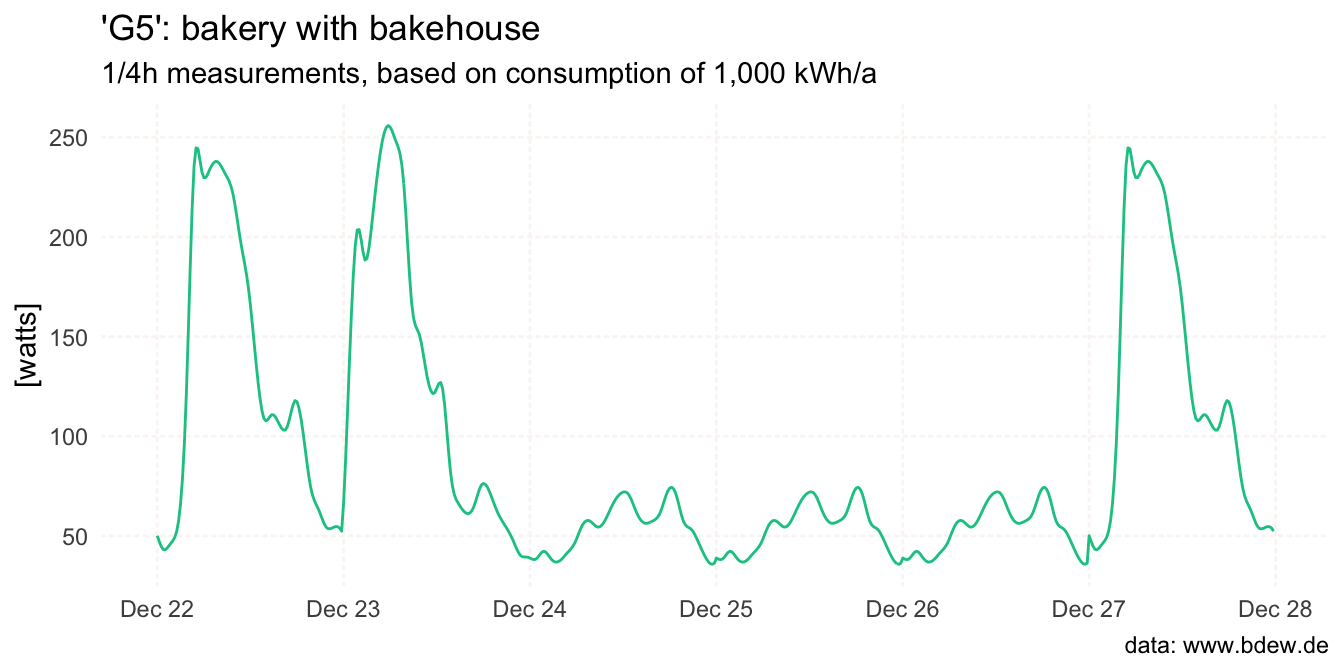
Both slp_electricity() and slp_gas() use
the same holiday logic: nine nationwide German public holidays are
treated as Sundays by default:
State-level holidays are not included because they vary by state and
year. Use the holidays argument in either function to
supply your own dates — the built-in data are then ignored entirely. See
the electricity
article for an example of how to fetch state-level holidays from the
nager.Date API.
slp_gas() implements the BDEW/VKU/GEODE
synthetic procedure (SigLinDe method) for daily gas consumption. The
gas consumption on any particular day is influenced by three
factors:
kundenwert)slp_gas() hence takes a date vector for which the gas
consumption should be calculated, a vector of daily mean temperatures
and a kundenwert (customer value in kWh/day), together with
one of 15 gas profile IDs.
Pass dates and temps to
slp_gas() together with the kundenwert.
The
kundenwertof 55.1 kWh/day is itself derived once, from the customer’s annual consumption and a reference temperature series. See the gas article for that step and the full method.
The result of slp_gas() is a data frame with three
columns: profile_id, date, and
kwh which is the daily gas consumption:
HEF <- slp_gas("HEF", dates, temps, kundenwert = 55.1)
head(HEF)
#>   profile_id       date      kwh
#> 1        HEF 2025-10-01 40.95047
#> 2        HEF 2025-10-02 32.50304
#> 3        HEF 2025-10-03 31.91795
#> 4        HEF 2025-10-04 27.32729
#> 5        HEF 2025-10-05 32.50304
#> 6        HEF 2025-10-06 30.17767
In the example above we assumed a single-family home (profile
HEF) in Düsseldorf.
In the following graph, we compare the same customer (i.e. we set the
kundenwert) for the same period – October 2025 to April
2026 – with three other locations. This allows us to isolate the
influence of the outside temperature on gas consumption in these
cities:
Each point represents a single day in the period from 1 October 2025 to 30 April 2026. Points above the 45° line indicate that the customer would have consumed more gas than in Düsseldorf. We can see that this winter was colder in all three cities than in Düsseldorf, so all the points lie above the line – most notably in Chemnitz, least so in Freiburg im Breisgau, with Hamburg in between:

For a detailed explanation of the SigLinDe parameters and the full climate zone comparison, see the gas articles on the package website.
Please note that this project is released with a Contributor Code of Conduct. By participating in this project you agree to abide by its terms.